BMR Machinery
Engineering Excellence
Discover the highly advanced Rotary PET Blow Moulding Machine by BMR Machinery. Engineered for maximum efficiency, speed, and durability. Get a quote today!
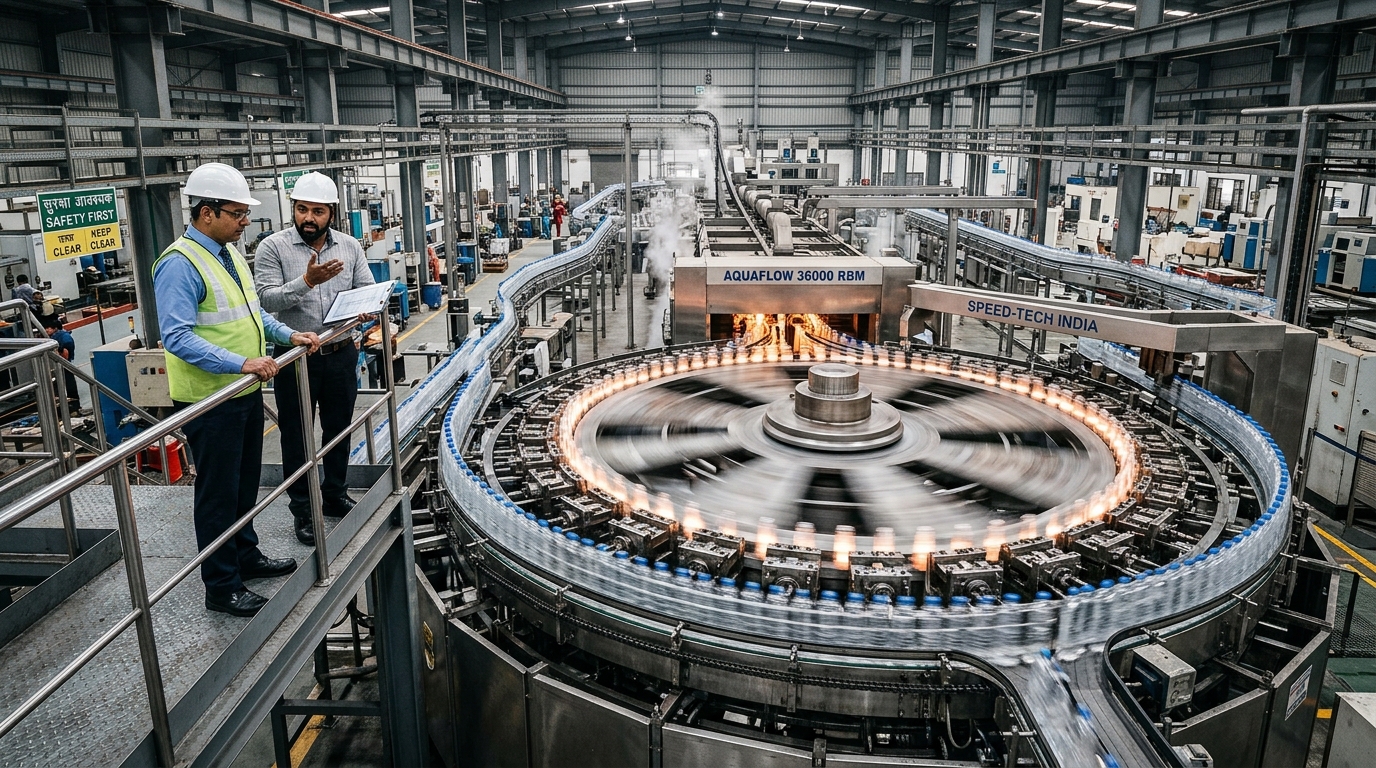
When beverage conglomerates and global water brands talk about mass production, they are not talking in terms of hundreds of bottles an hour; they are talking in terms of tens of thousands. The BMR Rotary PET Blow Moulding Machine is a colossal feat of engineering designed exclusively for hyper-scale, continuous, ultra-high-speed production. Operating on a continuous rotating carousel rather than a stop-and-go linear track, this machine is capable of churning out up to 36,000 bottles per hour (BPH) with flawless consistency.
Linear blow moulding machines are excellent, but they are limited by the laws of physics. The preforms must stop, the mold closes, the bottle blows, the mold opens, and the bottles move forward. This "stop-and-go" indexing takes time. A Rotary machine never stops. The molds are mounted on a massive, continuously spinning central carousel. The preforms enter seamlessly, the molds close while moving, the bottles are blown while rotating, and they are ejected without the machine ever pausing. It is a symphony of high-speed kinematics, aerodynamics, and thermal physics.
Building a machine that blows a bottle every 0.1 seconds while spinning at high RPM requires aerospace-level tolerances. The heart of the BMR Rotary Machine is the massive central distributor. This complex rotary joint must supply high-pressure air (40 bar), low-pressure control air, and chilled water to up to 24 rotating mold stations simultaneously, without leaking a single drop or PSI of pressure.
Furthermore, at these hyper speeds, heating the preforms requires a massive, multi-lane Infrared oven. The preforms travel through an incredibly long thermal tunnel to ensure they are heated gently and evenly despite the massive throughput speed. Once heated, robotic transfer wheels (star-wheels) equipped with specialized gripper jaws pluck the soft preforms from the oven and hand them off to the spinning molds with micro-millimeter precision.
The Rotary series is reserved for the highest echelons of beverage production. Its specifications represent the absolute limit of modern packaging technology.
| Parameter | Specification | Details |
|---|---|---|
| Production Speed | 12,000 to 36,000 BPH | Depending on cavity count (8 to 24 cavities) |
| Machine Architecture | Continuous Rotary Carousel | Eliminates stop-and-go indexing time |
| Bottle Volume Range | 200ml to 2500ml (2.5L) | High-speed CSD, Water, and Juice formats |
| Mold Stations | 8, 12, 16, 20, or 24 | Scalable modular stations |
| Air Distribution | Central Rotary Union | Zero-leakage high-pressure manifold |
| Stretch Rod Control | Mechanical Cam or Servo | Ensures identical stretch profiles across all stations |
| Heating Oven | Extended Multi-Lane IR | Active surface cooling for hyper-speed heating |
| Integration | Combi-Block Ready | Can be synchronized directly with rotary fillers |
| Footprint | Highly Compact vs Output | Replaces 3 to 4 linear machines |
To maintain absolute stability at 36,000 BPH, BMR Machinery integrates ultra-premium technologies into the Rotary series.
The Rotary machine is designed for mega-brands and massive contract packers.
A Rotary Blow Moulding Machine is a massive capital investment, typically reserved for factories pushing millions of units per month. However, the economies of scale it unlocks are unparalleled.
By replacing three or four linear machines with a single BMR Rotary machine, a plant manager slashes required floor space, reduces the required operating staff to a single person, consolidates maintenance schedules, and drastically lowers the per-bottle energy footprint. For a mega-plant, the ROI is usually achieved within 18 to 24 months based purely on the labor, floor space, and energy efficiency savings over multiple linear systems.
1. At what production volume does it make sense to upgrade from Linear to Rotary? Generally, if your plant requires a continuous output of over 10,000 to 12,000 bottles per hour, transitioning to a Rotary machine becomes economically and operationally superior to running multiple high-speed linear machines.
2. What happens if one mold station gets jammed or damaged? The BMR Rotary system is highly modular. Through the HMI touchscreen, you can electronically "deactivate" a single mold station. The machine will continue to run at high speed using the remaining 23 stations, simply skipping the blowing process for the deactivated mold until maintenance can be performed.
3. Can this machine be directly connected to my existing filling machine? Yes. If you have a rotary filling machine, we can engineer electronic synchronization (using servo-matching and encoders) to physically tie the outfeed star-wheel of the blower directly to the infeed of your filler, creating a seamless Combi-Block.
4. How difficult is a mold changeover on a 24-station machine? Despite having 24 molds, changeovers are surprisingly fast. The molds are designed as "quick-release shells." A well-trained team of three operators can swap all 24 mold shells and recall the new recipe in under 90 minutes.
5. How does the machine handle the massive compressed air requirement? The machine requires a heavy-duty, multi-stage High-Pressure Air Compressor network. However, our internal rotary manifold is engineered for zero leakage, and our Air Recovery System reclaims a massive portion of the exhaust air, making it far more efficient per bottle than a linear machine.
6. Is the heating oven rotary as well? No. The heating oven is a continuous linear chain. The preforms move linearly through the heating tunnel and are only transferred to the rotary motion when they are picked up by the infeed star-wheel just before entering the molds.
7. Can we blow complex asymmetrical shapes on a rotary machine? While possible, rotary machines are optimized for high-speed symmetrical shapes (round water/soda bottles). Complex asymmetrical or flat cosmetic bottles are usually better suited for advanced linear machines with preferential heating capabilities.
8. What kind of maintenance schedule does a rotary machine require? Due to the continuous physical motion, rotary machines require rigorous, scheduled preventive maintenance. However, BMR integrates an auto-lubrication system that continuously pumps precise amounts of grease to all critical cam tracks and bearings, drastically reducing daily manual maintenance.
9. Can it handle ultra-lightweight preforms (e.g., 8 grams)? Yes, perfectly. Because the mechanical cams dictate the stretch rod movement with absolute, unvarying physical precision, material distribution is flawless, making it the preferred machine for extreme light-weighting campaigns by major water brands.
10. How is the machine shipped and installed? Due to its massive size, the Rotary machine is usually shipped in major sub-assemblies (Oven, Main Carousel, Electrical Cabinets). BMR Machinery deploys a senior engineering team to your site for 3 to 4 weeks to reassemble, laser-align, and commission the machine, followed by extensive staff training.
Calculate your potential earnings with BMR Machinery
Includes Preform, Cap, Label & Electricity
Daily Profit
₹80,000
Yearly Profit
₹2,49,60,000
Note: This is a rough estimation. High-speed BMR machines reduce per-bottle electricity cost by up to 20%, increasing actual profits further.
Speak directly with our engineers to configure the perfect Rotary PET Blow Moulding Machine for your production facility.
Chat on WhatsAppCall 091376 87609Email Sales TeamReliable, efficient, and built to last — their machines have transformed our production line. Output doubled in 3 months!
BMR Machinery delivered a fully integrated mineral water plant setup on time. We've seen a 30% increase in output since installation.
Exceptional performance and great after-sales service. They truly deliver what they promise. Highly recommended!